Naive Bayesian classifiers are built on an assumption that’s almost always technically wrong, and they work well anyway often enough that the contradiction is worth understanding rather than glossing over.
The core idea: Bayes’ theorem applied to classification
Bayes’ theorem relates the probability of a class given the evidence to the probability of the evidence given the class, combined with how common each class is overall. Naive Bayesian classifiers apply this directly: for each possible class, compute how probable the observed features would be if that class were true, then pick whichever class makes the observed evidence most probable.
Why it’s called “naive”
The method assumes every feature is conditionally independent of every other feature, given the class. In plain terms: knowing one word appeared in an email tells you nothing extra about whether another word appeared, once you already know whether it’s spam. This is almost never literally true. Words in real text are correlated with each other constantly. The assumption is naive because it ignores that, on purpose, in exchange for a calculation that’s actually tractable.
Why the wrong assumption still produces useful results
Naive Bayes doesn’t need the independence assumption to be true to classify correctly, it only needs the relative ranking between classes to come out right. Even when the individual probability estimates are distorted by ignoring real feature correlations, the distortion often applies similarly enough across classes that the final classification decision still lands correctly more often than the broken assumption would suggest.
Where this fits among the classifiers already covered
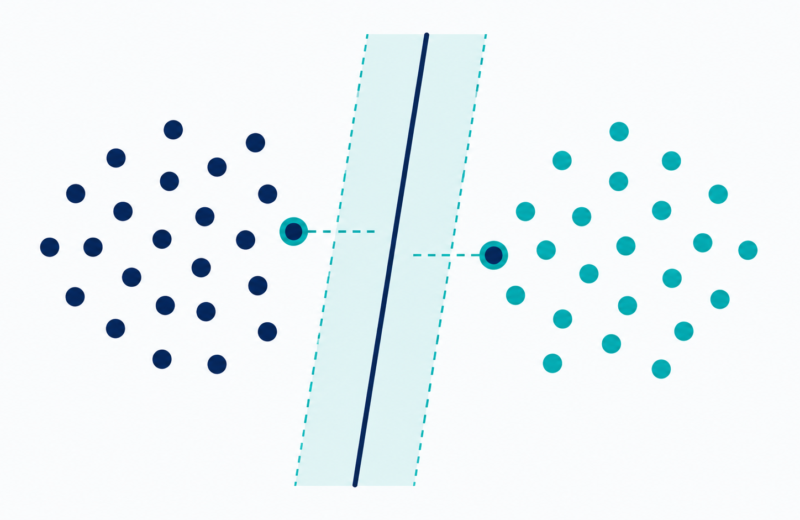
This is a fundamentally different approach from support vector machines, which make no probabilistic assumption at all and instead find a geometric boundary. Naive Bayes is explicitly probabilistic, modeling how likely each feature value is under each class, then combining those likelihoods. Where SVMs ask “which side of the boundary is this point on,” naive Bayes asks “which class would make this evidence most likely.”
Why it’s still a common choice for text classification
Naive Bayes is fast to train, requires relatively little data to produce reasonable estimates, and scales well to high-dimensional feature spaces like word counts across a large vocabulary, exactly the setting text classification problems usually present. That combination of speed and reasonable performance, even with a flawed assumption, is why it remains a standard baseline for spam filtering and document classification.
A quick checklist
- Are your features at least roughly independent given the class, or badly correlated in a way that could hurt the result?
- Do you have limited training data? Naive Bayes tends to need less data than more complex models to produce reasonable estimates.
- Is training speed or simplicity a priority, given naive Bayes is one of the fastest classifiers to train?
- Have you compared it against a baseline, the way any model evaluation should, rather than assuming it’s good enough on its own?
FAQ
Is naive Bayes still used despite its flawed assumption?
Yes, especially as a fast baseline for text classification, where it often performs surprisingly well relative to its simplicity.
What’s the difference between Gaussian and Multinomial naive Bayes?
Gaussian naive Bayes assumes continuous features follow a normal distribution within each class. Multinomial naive Bayes is built for count data, like word frequencies, which is why it’s the common choice for text classification.
Does naive Bayes require a lot of training data?
Less than many alternatives, since it estimates relatively simple per-feature statistics rather than complex decision boundaries, which is part of why it performs reasonably even on smaller datasets.