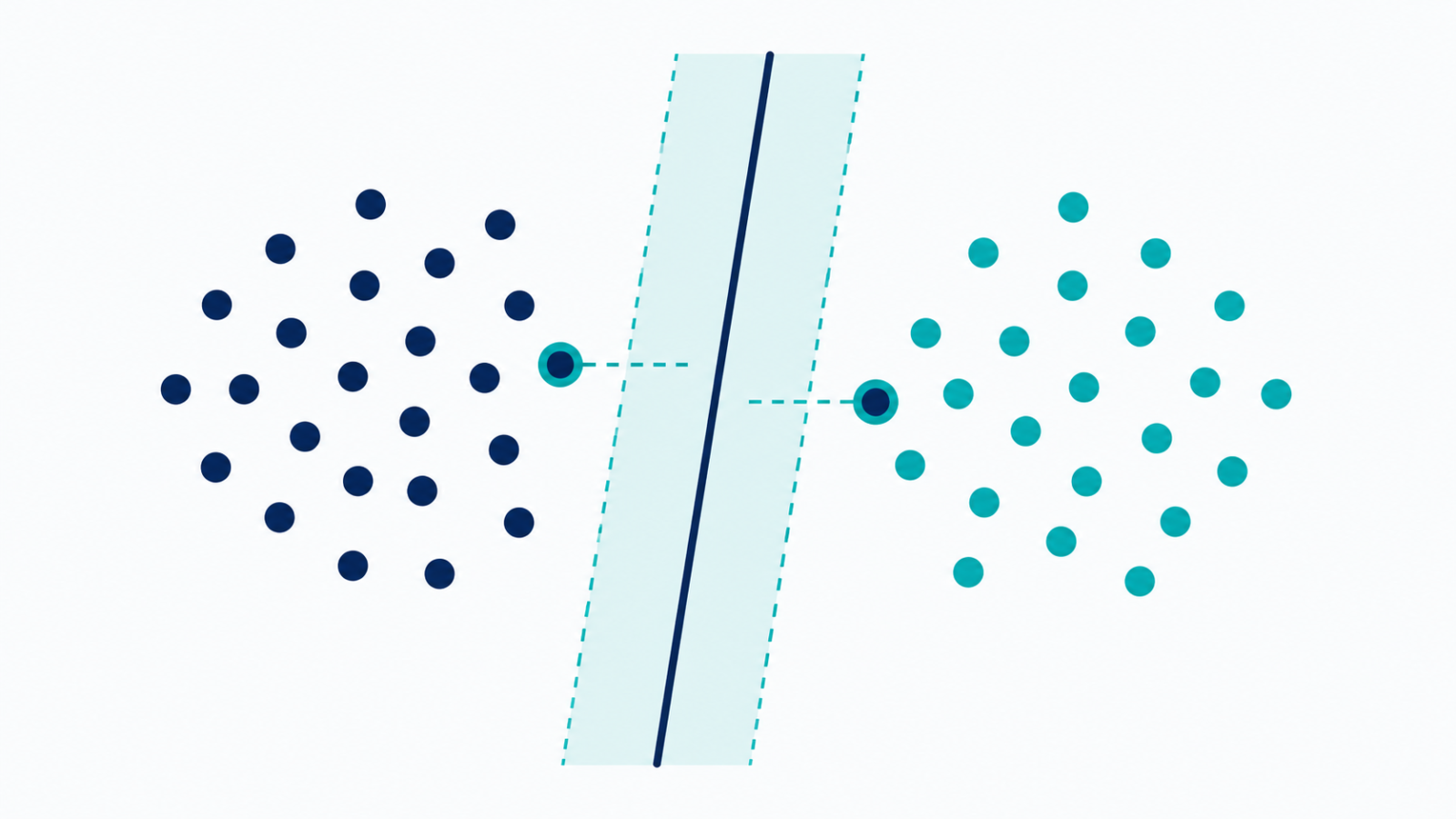
Plenty of lines can separate two classes of points on a plot. A support vector machine isn’t satisfied with just any of them. It specifically finds the one with the widest possible gap on either side, and that choice is the entire idea behind the algorithm.
What a support vector actually is
The support vectors are the specific data points closest to the decision boundary, the ones that would change the boundary’s position if they moved. Every other point, further from the boundary, could be removed without affecting where the line sits at all. The algorithm is named after exactly these points because they’re the only ones that actually determine the result.
Why maximizing the margin matters
A decision boundary squeezed tightly against the training data tends to generalize poorly, small variations in new data can land on the wrong side. A boundary with the widest possible margin, the maximum distance to the nearest points of each class, is more robust to exactly that kind of variation. Maximizing the margin isn’t a stylistic choice, it’s a direct attempt to minimize how easily new data gets misclassified.
What happens when classes aren’t cleanly separable
Real data rarely separates perfectly. A soft-margin SVM allows some points to sit on the wrong side or inside the margin, controlled by a penalty parameter that trades off margin width against how many misclassifications are tolerated. A small penalty allows more violations for a wider margin; a large penalty forces a tighter fit at the cost of a narrower one.
The kernel trick: separating what isn’t linearly separable
Some data simply isn’t separable by a straight line or flat plane, no matter how it’s drawn. The kernel trick maps data into a higher-dimensional space where a linear boundary becomes possible, without ever explicitly computing that higher-dimensional transformation. Common kernels, linear, polynomial, radial basis function, each assume a different kind of underlying structure, and choosing the right one matters as much as choosing the model itself.
Where this connects to other classifiers already covered
Unlike the naive Bayes approach, which models probability distributions over features, an SVM makes no probabilistic assumption about the data at all. It’s a purely geometric method, concerned only with where the boundary sits relative to the points nearest it. That’s a fundamentally different way of arriving at a classification decision, worth understanding as a contrast rather than just another option on a list.
A quick checklist
- Does your data look linearly separable, or would a kernel be needed to find a meaningful boundary?
- Have you tuned the penalty parameter to match how much misclassification tolerance actually fits your problem?
- Is your feature count large relative to your sample size? SVMs often perform well in exactly that setting.
- Would a probabilistic classifier better suit your needs, if you need calibrated probability outputs rather than just a boundary?
FAQ
Do support vector machines work for more than two classes?
Yes, through strategies like one-vs-rest or one-vs-one, which combine multiple binary SVM classifiers to handle multi-class problems.
Are SVMs still relevant compared to deep learning?
Yes, particularly for smaller datasets or high-dimensional data with relatively few samples, where SVMs often perform competitively without needing the volume of data deep learning typically requires.
Do SVMs output probabilities directly?
Not natively, the base algorithm outputs a geometric decision, though probability estimates can be added afterward through additional calibration.