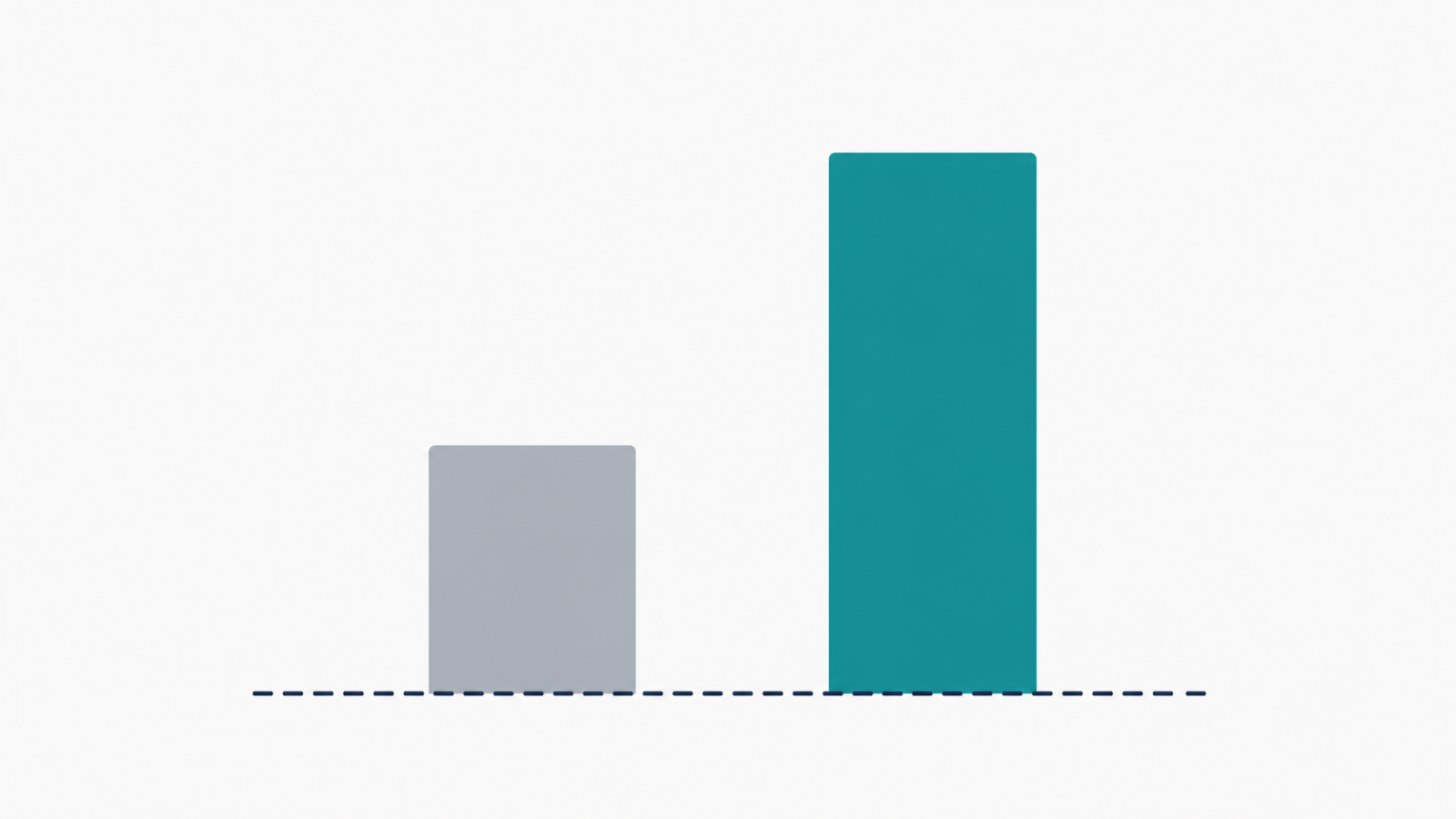
A model that scores 85% accuracy sounds good — until you learn a baseline model that always guesses the majority class scores 84%. Without that comparison, the number means almost nothing.
What a baseline model in machine learning actually is
A baseline model in machine learning is the simplest reasonable thing you could do instead of building a real model: predict the majority class, predict yesterday’s value, predict the historical average. It’s not meant to be good. It’s meant to set the floor your actual model has to clear before its result means anything.
Why a baseline model matters more than the headline metric
A metric with nothing to compare it to is a claim, not evidence. A baseline model in machine learning turns “this model scored 85%” into “this model beat the naive approach by 12 points” — the second version is the one that actually tells you whether the extra complexity was worth it.
A real example: benchmarking against literature
The fact-check triage NLP project, trained on the real LIAR dataset of labeled political statements, benchmarks its results directly against published literature on the same dataset — the baseline here isn’t a naive guess, it’s the best known prior result, which is a stronger and more honest bar to clear.
A real example: beating the naive forecast
For time series problems specifically, the obvious baseline model is often “tomorrow will look like today.” The bike-share demand forecasting project uses honest time-series validation splits precisely so its reported accuracy can be fairly compared against a naive lag-based baseline — without that discipline, a model can look impressive while barely beating what a simple lag would have predicted for free.
A real example: the majority-class trap
The network intrusion detection project reports per-class precision and recall on the NSL-KDD benchmark specifically because a majority-class baseline — always predicting “normal traffic” — would already score deceptively high accuracy on this kind of imbalanced security data, while catching zero actual attacks.
Picking the right baseline model
- Classification with imbalanced classes: the majority-class prediction, which sets an accuracy floor that’s often higher than expected.
- Time series forecasting: a naive lag (yesterday’s value, last week’s average), which is nearly free to compute and surprisingly hard to beat.
- An established research area: published results on the same dataset, when available — the strongest baseline model you can use, since it’s already been vetted by other researchers.
- No obvious baseline exists: the simplest model that could plausibly work — linear regression before a neural network, a single decision tree before an ensemble.
A quick checklist
- Have you computed what a majority-class or naive baseline model would score on this exact problem?
- Is your headline metric reported alongside that baseline, or standing alone?
- If a published benchmark exists for your dataset, have you compared against it directly?
- Would a reviewer be able to tell, from your write-up, how much better than “doing nothing clever” your model actually is?
FAQ
Is a baseline model the same thing as a control group?
Conceptually similar — both exist to isolate what your actual intervention (the model) contributed, rather than crediting it for improvements a naive approach would have gotten anyway.
What if my model barely beats the baseline?
That’s real information, not a failure to hide. It tells you the extra complexity may not be worth it yet, or that the problem needs better features, not a fancier algorithm.
Should I always report the baseline model’s score, even if my model wins easily?
Yes — it costs almost nothing to compute and it’s the single fastest way for a reviewer to trust the rest of your results.