Normalization and standardization are both ways of putting features on a comparable scale, and people often use the two words as if they meant the same thing. They don’t, and the choice affects some models far more than others.
What normalization does
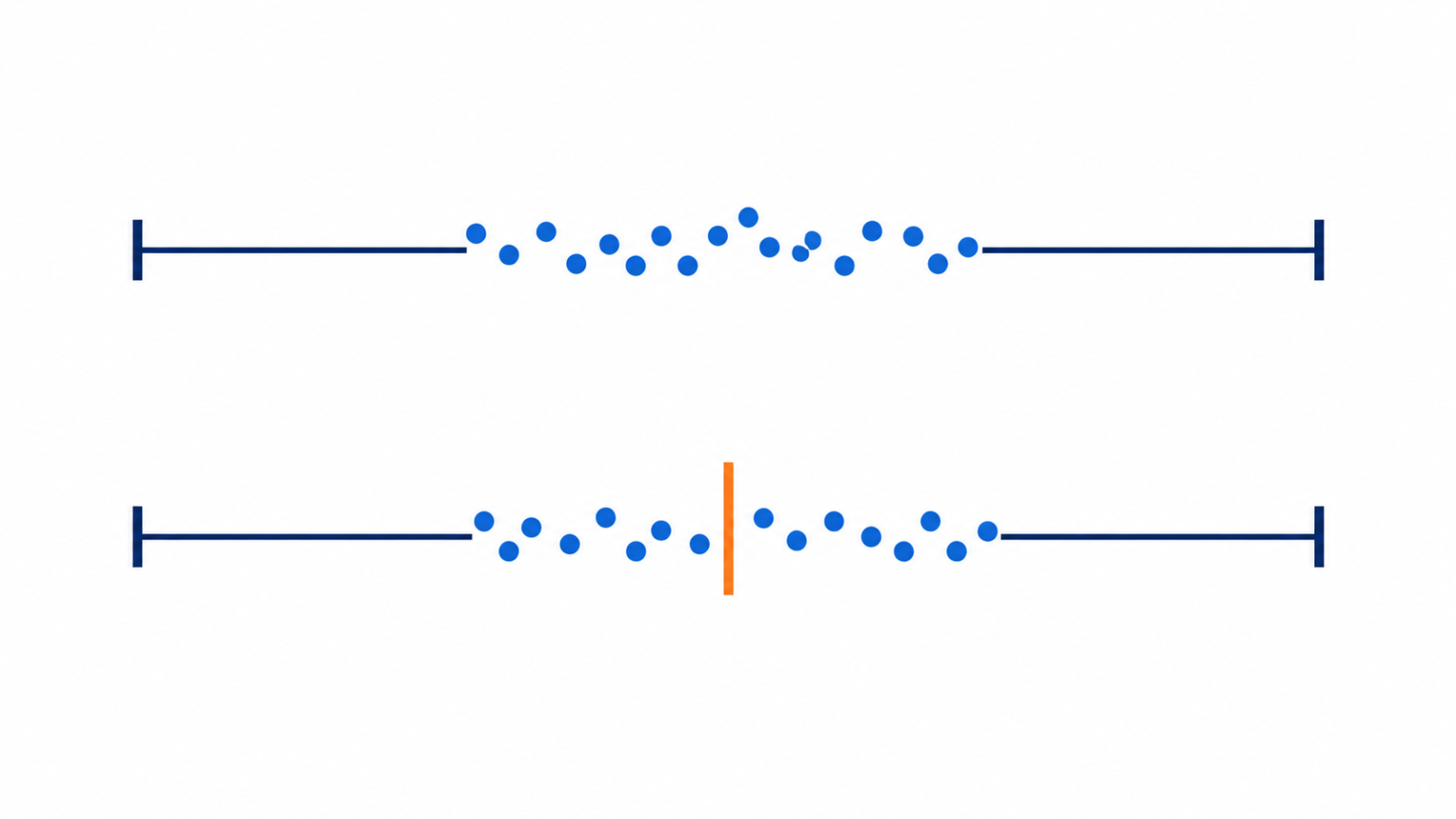
Normalization, usually meaning min-max scaling, rescales each feature to a fixed range, most often 0 to 1. Each value becomes its distance from the feature’s minimum, divided by the feature’s range. The result is bounded, which is useful when an algorithm expects inputs in a known range. The weakness is outliers: one extreme value stretches the range and squeezes everything else into a narrow band.
What standardization does
Standardization, also called z-score scaling, subtracts the feature’s mean and divides by its standard deviation. The result has a mean of 0 and a standard deviation of 1, but no fixed bounds. It is less distorted by a single outlier than min-max scaling, though extreme values still influence the mean and standard deviation. It is the common default for models that assume features are centered.
When to use which
Use standardization as the starting point for most models, especially those fit with gradient descent or regularization. Use min-max normalization when you need bounded inputs, such as for some neural network setups or image pixel values. If a feature has heavy outliers, consider robust scaling, which uses the median and interquartile range instead of the mean and standard deviation. Treat all of this as a default to check, not a law: compare results on your own validation data.
Which models need scaling at all
Scaling matters most for models that depend on distances or on coefficient size. That includes k-nearest neighbors, k-means, and anything that uses a distance between points. Support vector machines are a clear example, as covered in the SVM explainer. It also matters for linear and logistic regression with regularization, as in logistic regression and L1 and L2 regularization, and for principal component analysis, where a large-scale feature can dominate the result. Tree-based models are the usual exception: decision trees split on the ordering of values, so scaling doesn’t change them.
Fit the scaler on training data only
A scaler learns from data: the minimum and maximum, or the mean and standard deviation. If you fit it on the full dataset before splitting, information from the test set leaks into training. Fit the scaler on the training data, then apply that same fitted transformation to validation and test data. This is one of the quieter forms of data leakage, and a pipeline object that bundles the scaler with the model prevents it.
A quick checklist
- Does your model depend on distances or coefficient size, or is it tree-based?
- Are there outliers that would distort min-max scaling?
- Did you fit the scaler on training data only?
- Do you apply the same fitted scaler to new data at prediction time?
- Did you compare results with and without scaling on validation data?
FAQ
Is normalization the same as standardization?
No. Normalization usually rescales values into a fixed range such as 0 to 1, while standardization centers them on the mean with a standard deviation of 1.
Do I need to scale the target variable?
Usually not for classification. For regression it is optional and depends on the model, but remember to invert the scaling when you report predictions.
Should I scale before or after splitting the data?
After. Split first, fit the scaler on the training set, then apply it to the validation and test sets, so no information leaks from them.