Summing pixel values inside a rectangle, over and over, for thousands of candidate regions, would be unbearably slow if done naively. An integral image makes that same operation nearly instant, which is exactly why it shows up in real-time computer vision pipelines.
What an integral image actually is
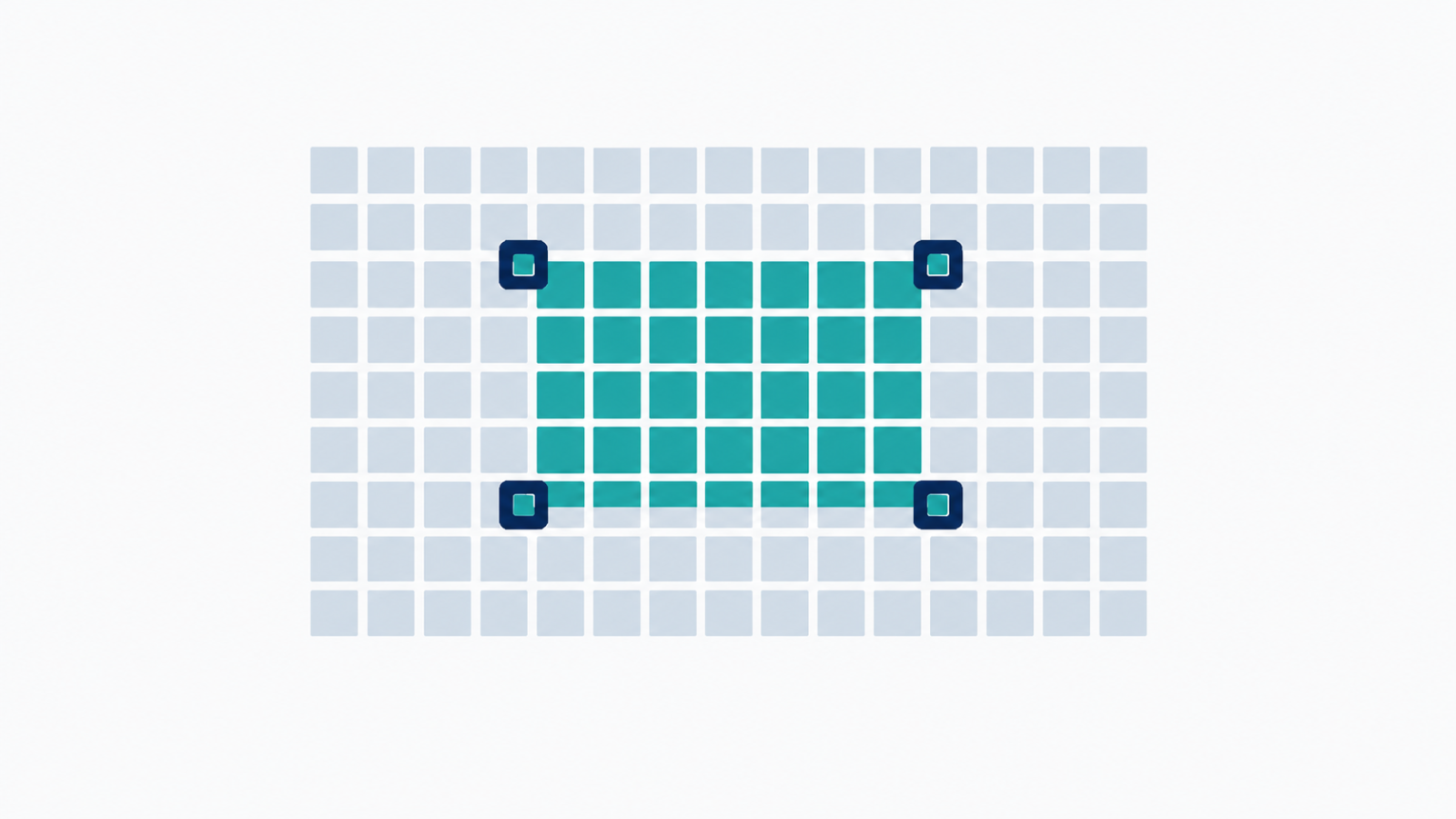
An integral image, also called a summed-area table, precomputes a running sum: each pixel in the integral image stores the total of every pixel above and to the left of it in the original image. Once that single precomputed table exists, the sum of any rectangular region can be calculated from just four lookups, regardless of how large the rectangle is.
Why this matters for speed
Without an integral image, summing a rectangular region means adding up every pixel inside it, work that scales with the rectangle’s area. With one, it’s four array lookups and three additions, constant time no matter the rectangle’s size. For a pipeline checking thousands of candidate regions at different scales, that difference is the gap between real-time and unusably slow.
Where this connects to feature extraction
The visual quality inspection project extracts explicit visual features, edges, texture, color distribution, rather than feeding raw pixels into an opaque model. Rectangular region-sum features, the kind an integral image accelerates, are a classic building block in exactly this style of explicit, interpretable feature engineering for images, long predating deep learning approaches that skip hand-designed features entirely.
How the four-lookup trick works
Given the integral image, the sum of any rectangle can be found by combining four corner values with simple addition and subtraction, adding the bottom-right corner, subtracting the two overlapping edges, and adding back the double-subtracted top-left corner. The exact arithmetic matters less than the underlying idea: a single precomputed table turns a per-region computation into a handful of constant-time lookups.
A quick checklist
- Does your pipeline need to compute rectangular region sums repeatedly, across many candidate regions or scales?
- Would precomputing an integral image once be cheaper than recomputing each region sum from scratch?
- Is your feature extraction interpretable by design, the way integral-image-based features tend to be, or does it rely on an opaque learned representation instead?
- Does your use case justify the one-time cost of building the integral image, or is the number of region queries too small to benefit?
FAQ
Is an integral image the same as a cumulative sum?
Related, yes. It’s essentially a two-dimensional cumulative sum, extending the same running-total idea from one dimension to two.
Do modern deep learning models still use integral images?
Less often directly, since convolutional networks learn their own feature representations, but the technique remains relevant in classical computer vision and performance-critical pipelines where hand-designed features are still preferred.
Does computing the integral image itself take extra time?
Yes, a one-time linear pass over the image, but that upfront cost pays for itself quickly once many region sums are needed afterward.