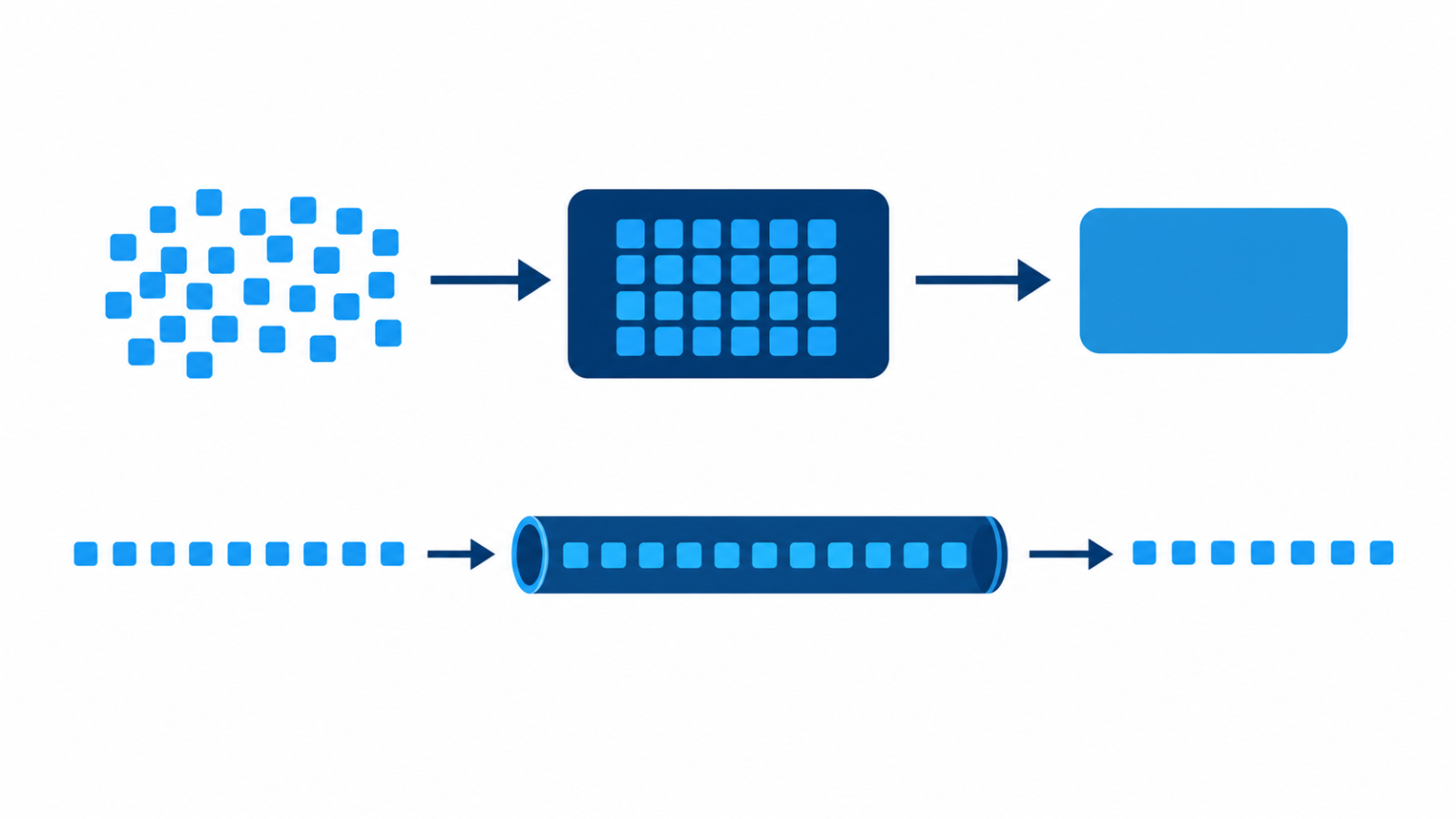
The choice between batch and streaming is really a question about time: how soon after something happens does someone need to see it in the data. Most of the cost and complexity of a pipeline follows from that single answer.
What batch processing does
Batch processing collects data over a period, then processes it together on a schedule, such as hourly or nightly. It is simpler to build, easier to test, and easy to rerun when something goes wrong. The trade-off is latency: results are only as fresh as the last completed run.
What streaming processing does
Streaming processing handles each event, or very small groups of events, as it arrives. Dashboards and alerts can update within seconds. Tools such as Apache Kafka, which acts as a durable log of events, and engines such as Apache Flink or Spark Structured Streaming are common building blocks. The price is a harder system to design and operate.
What makes streaming harder
Events can arrive late or out of order, so you have to decide whether to use the time an event happened or the time it was processed, and how long to wait for stragglers. Computations over time, such as counts per five minutes, need windows and stored state. Failures can cause the same event to be processed twice, so the processing has to tolerate repeats, which is the property described in idempotent data pipelines. Running it all reliably also takes more monitoring, in the spirit of data observability.
Real time often means fast enough
When people ask for real time, they often need data that is a few minutes old, not a few milliseconds. Frequent batch runs, or small micro-batches, can meet that need at much lower complexity. Ask what decision the fresh data supports and what a delay of five minutes, an hour or a day would actually cost. If nobody acts on the data faster than that, a full streaming system is unlikely to pay for itself.
When streaming is worth it
Streaming earns its complexity when the value of the data decays quickly: fraud checks while a payment is happening, alerts on equipment readings, or personalization within a session. In those cases a delay can mean the opportunity is already gone. The same trade-off exists on the model side, as covered in batch vs real-time inference.
The options in between
You do not have to pick one extreme. Change data capture reads a database’s change log to move updates continuously without rewriting whole tables, as compared in change data capture vs batch ETL. Many systems also run incremental batch loads, covered in incremental load vs full refresh, and use streaming only for the few data flows that truly need it. Whatever you run, an orchestrator still helps coordinate the batch parts.
A quick checklist
- What decision does the data support, and how fast must it be made?
- What does a delay of minutes, hours or a day actually cost?
- Can frequent batch or micro-batch runs meet the need?
- Can your processing tolerate late, out-of-order and repeated events?
- Does your team have the capacity to operate a streaming system?
If you are weighing the options for a pipeline, see my ETL and ELT engineering service.
FAQ
Is streaming always better than batch?
No. Streaming gives lower latency but adds complexity and operating cost. For many reporting and analytics needs, batch is simpler, cheaper and fast enough.
What is micro-batching?
It is processing data in very small, frequent batches, often every few seconds or minutes. It sits between traditional batch and true event-by-event streaming.
Is Kafka a stream processing engine?
Not by itself. Kafka stores and delivers streams of events. A separate engine or library, such as Flink, Spark Structured Streaming or Kafka Streams, does the processing.