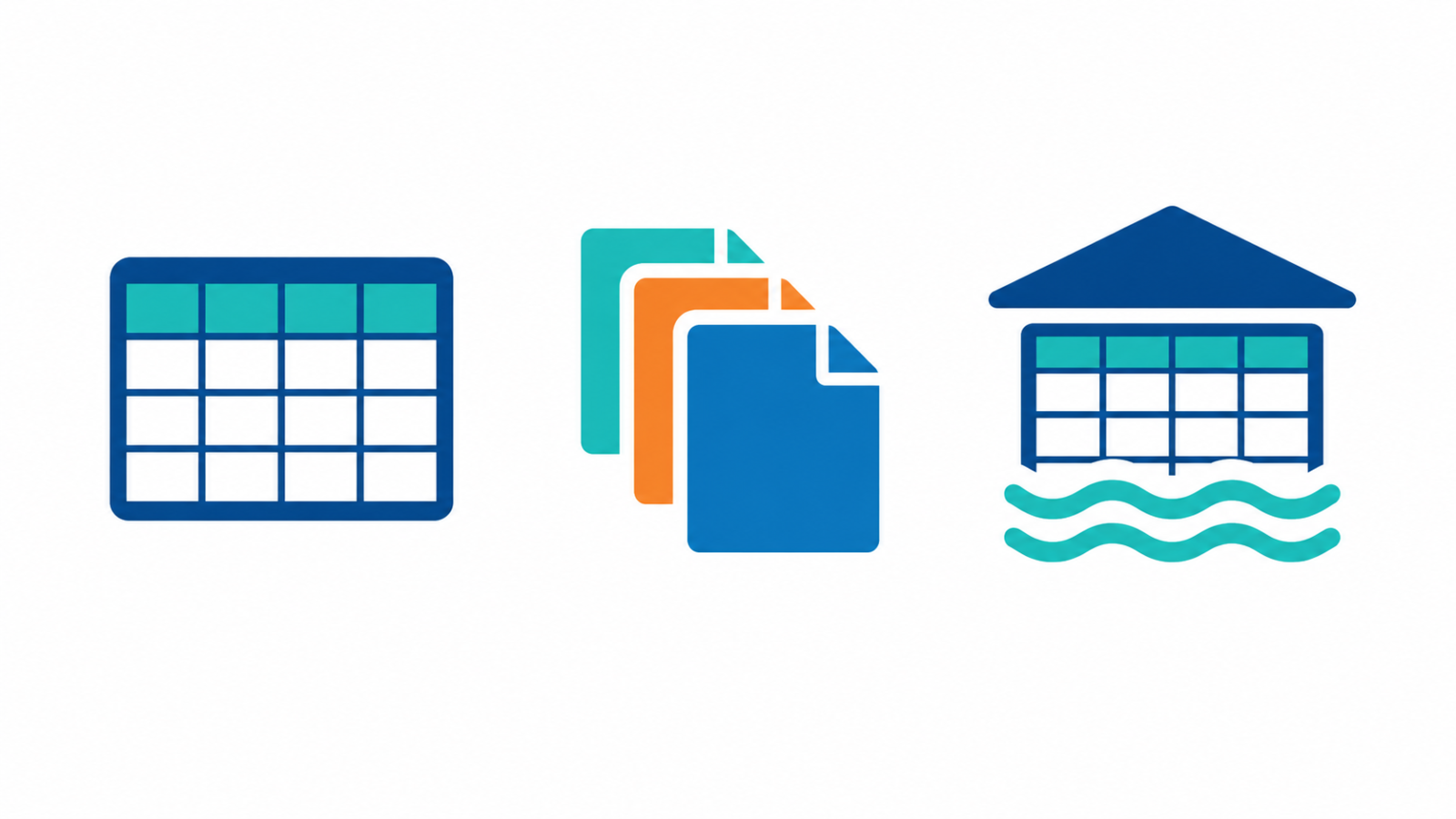
A warehouse stores modeled tables, a lake stores raw files, and a lakehouse tries to do both. The right choice depends less on the label and more on what your data looks like and who needs to query it.
What a data warehouse is
A data warehouse stores structured data in tables with a defined schema, and it is built for fast SQL analytics. Data is cleaned and modeled before or as it lands, so analysts query consistent tables. The modeling choices inside it, such as star schema versus snowflake schema, shape how easy those queries are.
What a data lake is
A data lake stores data in its raw form, usually as files on cheap object storage. It can hold structured tables, semi-structured formats like JSON, and unstructured data such as images or logs. The schema is applied when you read the data, not when you write it. That flexibility is the appeal, and the risk: without naming rules, ownership and cataloging, a lake turns into a pile of files nobody trusts.
What a lakehouse adds
A lakehouse keeps data in open files on object storage, then adds a table layer on top, using formats such as Delta Lake, Apache Iceberg or Apache Hudi. That layer provides transactions and table-style SQL access over lake data, so one copy of the data can serve both analytics and data science work. It reduces duplication, but it also adds a layer you have to operate and understand.
How to choose
Choose a warehouse when your data is mostly structured, your main users are analysts and BI tools, and you want the least operational overhead. Choose a lake when you need to keep large volumes of raw or unstructured data cheaply, or when machine learning workloads need file-level access. Consider a lakehouse when you need both and want to avoid copying data between two systems. Moving data into any of them follows the same decision covered in ETL versus ELT.
You may not need any of them yet
For a small team or a small dataset, a managed warehouse or even a local engine can be enough. Running a full lakehouse for a few gigabytes adds cost and maintenance without a clear benefit. The dbt and DuckDB versus a cloud warehouse comparison covers where that line sits.
What matters regardless of the choice
Whichever you pick, a few habits decide whether the platform stays trustworthy. Track data lineage so you can trace a number back to its source. Plan table partitioning before tables get large, since that affects both cost and query speed. And document who owns each dataset.
A quick checklist
- Is most of your data structured, or do you also have JSON, logs, images or other raw files?
- Who queries it: analysts and BI tools, data scientists, or both?
- Do you need to keep raw data you may reprocess later?
- Can your team operate an extra table layer, or do you want a managed service?
- Is your data volume large enough to justify more than a single warehouse?
If you are planning a platform and want a second opinion, see my cloud data warehousing service.
FAQ
Is a lakehouse replacing the data warehouse?
Not across the board. Lakehouses suit teams that need analytics and data science on the same data, while a plain warehouse is often simpler for mostly structured, analyst-driven work.
Can a data lake replace a warehouse?
A raw lake alone usually can’t, because analysts need consistent, modeled tables. Teams typically add a modeling layer or a table format on top.
Which is cheapest?
It depends on data volume, query patterns and how much operational work your team takes on. Object storage is cheap per gigabyte, but compute and maintenance costs differ by setup, so compare using your own workload.