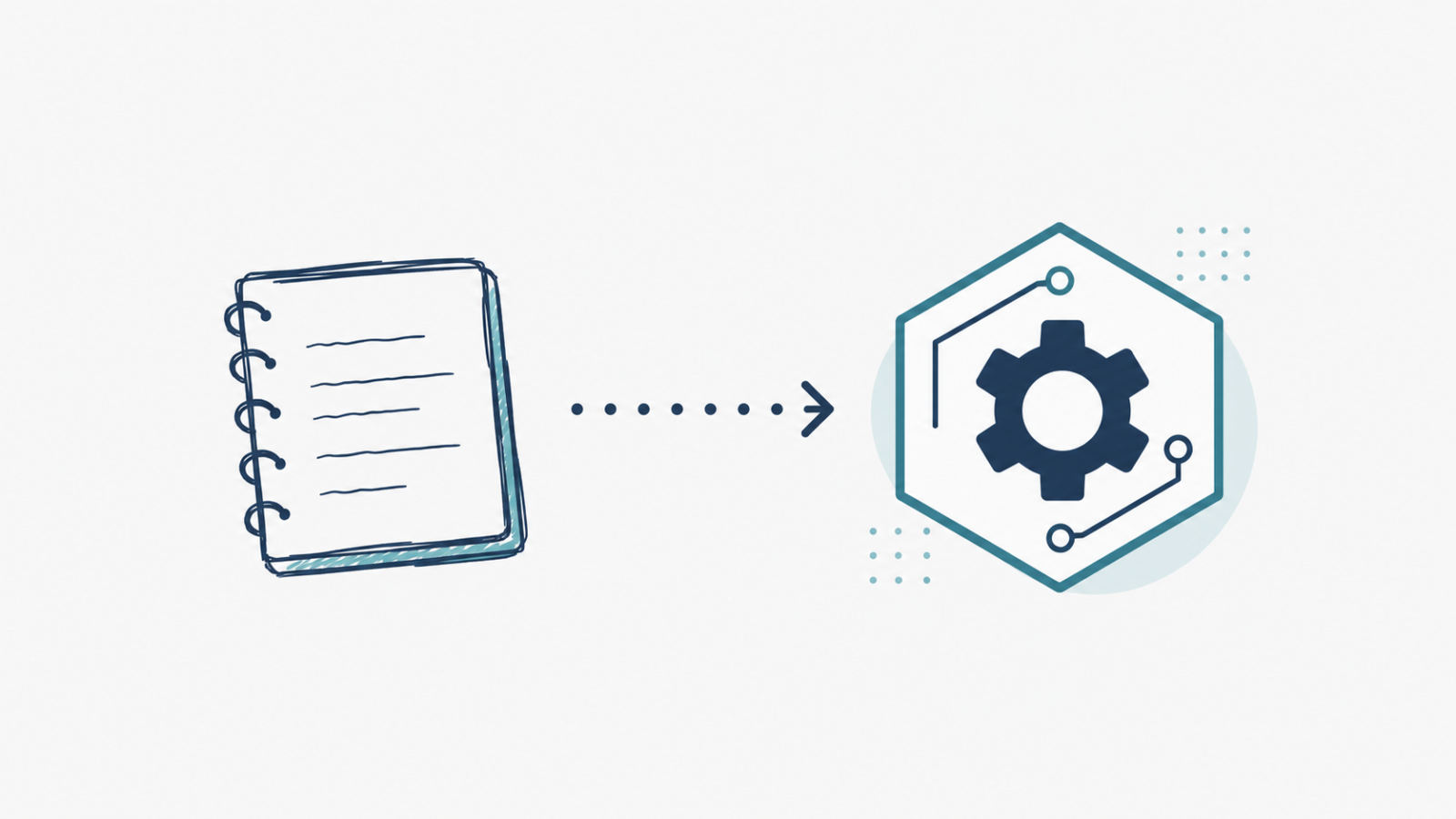
A Jupyter notebook that prints an accuracy score is a script. A data product is something a stranger could use without reading your code. Most portfolios stop at the first one and call it the second.
The gap between “it works” and “you can use it”
A model that only runs inside your notebook, on your machine, with your exact environment, isn’t deployed — it’s a demo you have to personally operate. The gap between the two is usually three things: a serving layer someone else can call, a way to compare model versions honestly, and an interface a non-technical reviewer can actually click through.
Give it a way to be called
A trained model sitting in a .pkl file has no way to answer a question at the moment someone asks it. Wrapping it behind an API turns “I ran this once and got a number” into “you can query this right now.” The movie recommender system and bike-share demand forecasting project both serve their models through a FastAPI endpoint for exactly this reason — the model stops being a one-time result and becomes something a reviewer can actually hit with a request.
Track versions instead of overwriting them
Retraining a model and overwriting the old file destroys the one thing a reviewer wants to see: whether the new version is actually better, and by how much. The support ticket triage platform tracks every model iteration in MLflow, so a new version gets compared against the previous one before it’s trusted to route real tickets — not just assumed to be an improvement because it’s newer.
Give non-technical reviewers a way in
A hiring manager or a non-technical stakeholder is not going to clone your repo and run a notebook cell by cell. If the only way to see your work is to read code, most reviewers never will. A UI removes that barrier entirely:
- The support ticket triage platform above is exposed through a Gradio interface for real-time testing and demoing — a reviewer can type a ticket and immediately see the predicted category and priority.
- The Olist e-commerce analytics engineering project puts a self-serve Streamlit dashboard on top of its dbt star schema, so a non-technical stakeholder can explore sales, delivery performance, and customer behavior without writing a line of SQL.
Neither of these UIs is complicated to build. That’s the point — the barrier to adding one is low, and skipping it is one of the easiest ways a strong technical project fails to land with the person reviewing it.
Make correctness visible, not just claimed
A model prediction with no explanation is a black box a reviewer has to trust blindly. The visual quality inspection project takes the opposite approach at the feature level: it extracts explicit, inspectable visual features — edges, texture, color distribution — rather than feeding raw pixels into an opaque network, so the classifier’s decision traces back to features a human can actually reason about.
The same principle shows up at the prediction level in the bike-share forecasting project, where SHAP explains which specific factors are driving each hour’s predicted demand. In both cases, the goal is the same: a reviewer shouldn’t have to take the model’s word for it.
A quick checklist: script or product?
- Can someone use it without running your code themselves — an API, a UI, anything?
- If you retrain the model tomorrow, can you tell whether the new version is actually better?
- Can a non-technical person interact with a result, or does understanding it require reading Python?
- If someone asks “why did it predict that,” do you have an answer beyond “the model said so”?
A project that answers yes to all four reads as engineering. A project that answers no to all four reads as a tutorial that was followed once. Most portfolios sit somewhere in between — which is exactly where a small amount of extra work has an outsized effect on how the whole project is judged.
FAQ
Do I need Docker and Kubernetes to make a project “production-grade”?
No. A FastAPI or Gradio app running locally already clears the bar of “someone else can use this.” Containerization matters more for the deployment story than for whether the underlying engineering is sound.
Is MLflow overkill for a portfolio project?
Not if you retrain anything more than once. Even a lightweight experiment log — what changed, what the metric was — demonstrates the habit that matters, which is comparing versions instead of assuming improvement.
What’s the fastest way to add a UI to an existing model?
Gradio and Streamlit can both wrap an existing trained model in under 20 lines of code. Neither requires frontend experience, and both are enough to let a reviewer interact with your work directly.